


L.U.P. BYL8VW: When Innovation Turns Tool Life into Productivity
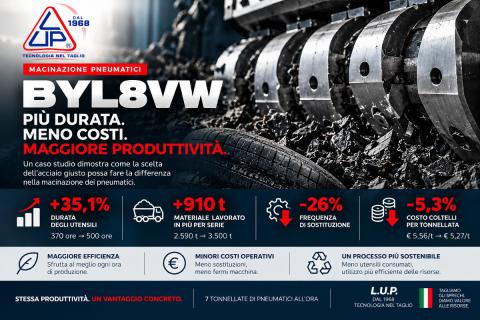
A case study in tire recycling demonstrates how choosing the right steel can improve production efficiency, reduce operating costs, and contribute to industrial sustainability.
In the recycling industry, efficiency is not only about transforming waste into valuable resources. It is also about how effectively we achieve that transformation.
This belief drives L.U.P.'s commitment to developing and applying high-performance materials for industrial cutting tools.
Since 1968, our company has been operating in the industrial cutting sector, addressing a challenge that has become increasingly important: improving tool performance while reducing operating costs and resource consumption.
Following the successful results achieved with BYL8SMAX steel, L.U.P. presents a new application case study confirming the value of material innovation: the use of BYL8VW steel in the production of industrial knives for end-of-life tire shredding and grinding applications.
The Challenge: Improving a Highly Demanding Industrial Process
Tire shredding and grinding are among the most demanding applications for industrial cutting tools.
The presence of rubber, textile reinforcements, and metallic components subjects cutting knives to particularly severe mechanical stresses and abrasive wear.
In this environment, tool life is not simply a technical parameter. It is a key factor directly affecting the operating economics of the entire processing plant.
Every tool replacement involves production downtime, specialized personnel, and the consumption of additional resources.
L.U.P.'s objective was therefore to determine whether an alternative material to conventional 1.2379 tool steel could provide a measurable and repeatable performance advantage.
The Case Study: 1.2379 vs. BYL8VW
The application test was conducted on a tire processing system equipped with 288 industrial knives per complete set.
Two solutions were compared: knives manufactured from conventional 1.2379 tool steel and knives produced by L.U.P. using BYL8VW steel.
Both materials achieved the same operating throughput of 7 metric tons of processed material per hour.
However, the results revealed a significant difference in tool life.
| Parameter | 1.2379 Steel | BYL8VW Steel |
|---|---|---|
| Knives per set | 288 | 288 |
| Tool life | 370 hours | 500 hours |
| Processing capacity | 7 t/h | 7 t/h |
| Material processed per set | 2,590 t | 3,500 t |
| Unit cost per knife | EUR 50 | EUR 64 |
| Tooling cost per metric ton | EUR 5.56/t | EUR 5.27/t |
BYL8VW achieved a 35.1% increase in tool life, allowing an additional 910 metric tons of material to be processed before knife replacement.
This result is particularly significant considering that the unit purchase price of BYL8VW knives is 28% higher than that of conventional 1.2379 knives.
The higher initial investment is offset by the extended operating life of the tools.
Case Study: Key Results at a Glance
| Performance Indicator | BYL8VW Improvement |
|---|---|
| Increase in tool life | +35.1% |
| Additional material processed per set | +910 metric tons |
| Reduction in replacement frequency | -26% |
| Reduction in tooling cost per metric ton | -5.3% |
Results refer to the comparison between BYL8VW and 1.2379 steel in tire shredding and grinding operations, with a processing capacity of 7 metric tons per hour.
The Real Advantage: More Production, Less Downtime
In an industrial plant, the true cost of a cutting tool is not limited to its purchase price.
To evaluate its actual economic impact, replacement frequency and maintenance downtime must also be considered.
In the application examined, replacing the complete set of 288 knives requires two working days and two operators.
Assuming an annual operating schedule of 220 working days, with one 8-hour shift per day, the annualized theoretical comparison highlights an additional advantage of BYL8VW.
Thanks to its extended tool life, replacement frequency is reduced by approximately 26%.
This translates into more than 18 hours of avoided machine downtime per year, equivalent to approximately 129 additional metric tons of tires processed within the same available operating time.
This is not simply about making a knife last longer.
It is about improving the productivity of the entire processing plant.
Efficiency Delivers Measurable Economic Value
The comparison also demonstrates that a material with a higher purchase price can deliver genuine cost savings.
Despite its higher unit cost, BYL8VW reduces tooling expenditure from approximately EUR 5.56 to EUR 5.27 per metric ton of processed material.
Additional benefits arise from fewer knife replacements, reduced maintenance labor, and increased equipment availability.
Assuming an indicative labor cost of EUR 30 per hour, the annual simulation indicates direct savings of approximately EUR 3,900, without assigning any economic value to the additional production capacity.
The additional output represents a further potential benefit, whose actual financial value depends on the operating margins and economic characteristics of the individual processing facility.
Sustainability: Making Better Use of Resources
There is another important aspect that goes beyond the immediate economic results.
Industrial sustainability is not achieved solely by recovering materials from waste. It also requires improving the efficiency of the processes that make recovery possible.
A longer-lasting cutting tool reduces the number of replacements required to process the same quantity of material.
This means fewer knives consumed, fewer worn-out tools requiring disposal or recycling, and more efficient use of the resources involved in tool manufacturing.
It also means fewer maintenance interventions and more effective utilization of available production time.
These are tangible operational benefits, although any associated reduction in energy consumption or carbon emissions would require additional measurements and verification.
For L.U.P., sustainability also means achieving more with the resources we already use.
Innovation Is Not a Promise. It Is a Measurable Result.
The BYL8VW case study provides another example of the philosophy driving L.U.P.: going beyond the manufacturing of industrial knives to continuously identify solutions capable of improving our customers' production processes.
Steel selection, material performance evaluation, and the verification of results under real operating conditions are essential elements of an innovation strategy combining manufacturing experience, metallurgical expertise, and a strong focus on customer operating economics.
Following the positive experience with BYL8SMAX, BYL8VW once again demonstrates the importance of looking beyond purchase price and evaluating the total operating cost of industrial cutting tools.
Because genuine innovation does not always require replacing an entire machine or completely redesigning a production process.
Sometimes, it simply begins with choosing a better material.
35% longer tool life. Fewer replacements. Higher productivity. Lower tooling cost per metric ton processed.
Results that turn a technical decision into a measurable industrial advantage.
L.U.P. – Innovation and technology in industrial cutting since 1968.
Cutting waste. Creating value from resources.
 Italiano
Ecomondo 2026

Saremo Presenti a Ecomondo 2026
We Exhibit at Ecomondo 2026
DAL 3 AL 6 NOVEMBRE 2026
PAD. A3 - STAND 110
50th Anniversary LUP di Bailotti 1968 - 2018

Aiuti di Stato
Obblighi informativi per le erogazioni pubbliche:
Gli aiuti di stato e gli aiuti de minimis ricevuti dalla nostra impresa, sono contenuti nel registro nazionale degli aiuti di Stato di cui all'art.52 della Legge 234/2012, consultabile al seguente Link: inserendo come chiave di ricerca nel campo "Codice fiscale" 00189670300